﻿<?xml version="1.0" encoding="UTF-8"?>

<!DOCTYPE html PUBLIC
    "-//W3C//DTD XHTML 1.1 plus MathML 2.0 plus SVG 1.1//EN"
    "xhtml-math-svg.dtd">
<?xml-stylesheet type="text/xsl" href="../../w3/pmathml.xsl"?>

<!--
  pref:renderer="techexplorer-plugin"
  pref:renderer="techexplorer"
  pref:renderer="css"
  pref:renderer="mathplayer"
  pref:renderer="mathplayer-dl"
-->

<html xmlns="http://www.w3.org/1999/xhtml" xml:lang="en">

<head>

<title>Errata - From Discourse to Logic</title>

<meta http-equiv="pics-label" content='(pics-1.1 "http://www.icra.org/ratingsv02.html" comment "ICRAonline EN v2.0" l gen false for "http://www.golgotha.org.uk/books/errata/discourse.xml" r (nz 1 vz 1 lz 1 oz 1 cz 1) "http://www.rsac.org/ratingsv01.html" l gen false for "http://www.golgotha.org.uk/books/errata/discourse.xml" r (n 0 s 0 v 0 l 0))' />

<link type="text/css" rel="stylesheet" href="../../golgotha.css" />

</head>


<body>

<p><a href="index.html">Book errata - index</a></p>

<h1>From Discourse to Logic</h1>

<h2>Overview</h2>

<p>Book: From Discourse to Logic, Student Edition, first printing (paperback)<br />
ISBN: 0-7923-1028-4</p>

<p><a href="http://www.wkap.nl/prod/b/0-7923-1028-4">Official book website</a> (no errata page at present)</p>

<p>Status: I emailed Hans Kamp with a copy of this errata list on 2003-09-11, but to date I have not received any reply.</p>

<h2>Administrivia</h2>

<p>This page uses MathML to display equations. If you can't see them, you will need to install a suitable <a href="http://www.w3.org/Math/implementations.html">viewer</a>. I personally use <a href="http://www.dessci.com/en/products/mathplayer/welcome.asp">MathPlayer</a>.</p>

<p>This page also uses SVG. If you can't see the figures below, you will need to install a suitable <a href="http://www.w3.org/Graphics/SVG/SVG-Implementations.htm8#viewer">viewer</a>, such as the <a href="http://www.adobe.com/svg/viewer/install/main.html">Adobe plug-in</a>.</p>

<h2>Errata</h2>

<p class="ErrataPage">Page 69:</p>

<p>In (1.20), it should say "Gen = male" rather than "Gen = -hum"</p>

<p class="ErrataPage">Page 93:</p>

<p>Footnote 8 refers to [Lewis 1986], but that entry doesn't appear in the bibliography.</p>

<p class="ErrataPage">Page 95:</p>

<p>M<sub>3</sub> doesn't actually extend M<sub>2</sub> (as claimed on p96), because owns<sub>M<sub>3</sub></sub> doesn't include the tuple &lt;c,f&gt;. fascinates<sub>M<sub>3</sub></sub> is a superset of fascinates<sub>M<sub>2</sub></sub>, but this would be clearer if &lt;d,a&gt; appeared between &lt;c,a&gt; and &lt;c,b&gt;, i.e. if all the elements of fascinates<sub>M<sub>2</sub></sub> came first followed by the new elements.<br />
N.B. This doesn't affect the truth of the DRSs in the models.</p>

<p class="ErrataPage">Page 96:</p>

<p>Does it actually make sense to say "Pred<sub>M'</sub>(Q) &#x2229; U<sub>M</sub>"? This seems ok for unary predicates, but I would think that it has problems for n-ary predicates when n>=2. For instance, if you take the intersection of owns<sub>M<sub>2</sub></sub> and U<sub>M<sub>1</sub></sub>, you are comparing pairs (e.g. &lt;a,d&gt;) to individual elements (e.g. a), so I would expect the result to be either unspecified or an empty set. I would phrase the definition differently - something like: Pred<sub>M</sub>(Q) = {&lt;x<sub>1</sub>, x<sub>2</sub>, ..., x<sub>n</sub>&gt; | &lt;x<sub>1</sub>, x<sub>2</sub>, ..., x<sub>n</sub>&gt; &#x2208; Pred<sub>M'</sub>(Q) &#x2227; x<sub>1</sub> &#x2208; U<sub>M</sub> &#x2227; x<sub>2</sub> &#x2208; U<sub>M</sub> &#x2227; ... &#x2227; x<sub>n</sub> &#x2208; U<sub>M</sub>}</p>

<p class="ErrataPage">Page 132:</p>

<p>Minor typo: in the final paragraph, "DRS-conditons" should be "DRS-conditions".</p>

<p class="ErrataPage">p163:</p>

<p>In question 4, "him to Bill" should say "he to Bill".</p>

<p class="ErrataPage">Page 202:</p>

<p>It seems that the specialised variant of the construction rule "CR.OR" for NP is unnecessary, since the standard rule will do the job perfectly well.</p>

<p>In case (i), they are equivalent. You can verify this by using example (2.129): "Smith or Jones loves Lady Hermione".</p>

<p>I also think that part (ii) of the NP variant is incorrect. Consider the sentence "Lady Hermione loves Smith or Jones", which we would like to split up into "Lady Hermione loves Smith or Lady Hermione loves Jones". The initial tree would be:</p>

<div><object type="image/svg+xml" data="d2l_s.svg" width="600" height="300">
<pre>
	S
   /         \
  NP         VP'
   |          |     \
  PN          V       NP
   |          |        |     \  \
  Lady H      loves    NP    or  NP
                       |         |
                       PN        PN
                       |         |
                       Smith     Jones
</pre>
</object></div>

<p><a href="d2l_s.svg">Sentence structure (SVG)</a> (in case it's not visible above).</p>

<p>So, NP<sub>1</sub> =</p>

<div><object type="image/svg+xml" data="d2l_np1.svg" width="100" height="150">
<pre>
NP
|
PN
|
Smith
</pre>
</object></div>

<p><a href="d2l_np1.svg">Noun phrase structure (SVG)</a> (in case it's not visible above).</p>

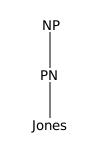
<p>and NP<sub>2</sub> =</p>

<div><object type="image/svg+xml" data="d2l_np2.svg" width="100" height="150">
<pre>
NP
|
PN
|
Jones
</pre>
</object></div>

<p><a href="d2l_np2.svg">Noun phrase structure (SVG)</a> (in case it's not visible above).</p>

<p>This would match condition (ii) of CR.OR(NP), where γ =</p>

<div><object type="image/svg+xml" data="d2l_vp.svg" width="250" height="150">
<pre>
VP'
|     \
V       NP
|        |     \  \
loves    NP1   or  NP2
</pre>
</object></div>

<p><a href="d2l_vp.svg">Verb phrase structure (SVG)</a> (in case it's not visible above).</p>

<p>and
<math xmlns="http://www.w3.org/1998/Math/MathML">

  <mover>

    <mi>γ</mi>
    <mo>-</mo>
  </mover>
  <mo>=</mo>
</math>
</p>

<div><object type="image/svg+xml" data="d2l_sg.svg" width="200" height="100">
<pre>
	S
   /         \
  NP          γ
</pre>
</object></div>

<p><a href="d2l_sg.svg">Sentence structure (SVG)</a> (in case it's not visible above).</p>

<p>So, following the bottom line of the construction rule, we would replace
<math xmlns="http://www.w3.org/1998/Math/MathML">

  <mover>

    <mi>γ</mi>
    <mo>-</mo>
  </mover>
</math>
by:</p>

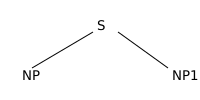
<div><object type="image/svg+xml" data="d2l_snp1.svg" width="200" height="100">
<pre>
	S
   /         \
  NP         NP1
</pre>
</object></div>

<p><a href="d2l_snp1.svg">Sentence structure (SVG)</a> (in case it's not visible above).</p>

<p>or</p>

<div><object type="image/svg+xml" data="d2l_snp2.svg" width="200" height="100">
<pre>
	S
   /         \
  NP         NP2
</pre>
</object></div>

<p><a href="d2l_snp2.svg">Sentence structure (SVG)</a> (in case it's not visible above).</p>

<p>In other words, we would get "Lady Hermione Smith or Lady Hermione Jones", which isn't what we want.</p>

<p>As mentioned above, the original version of CR.OR (on p197) would be correct here, since it would substitute in NP<sub>1</sub> and NP<sub>2</sub> for the second NP in the original sentence.</p>

<p class="ErrataPage">Page 203:</p>

<p>Since CR.OR(NP) is redundant (as explained above), that means that CR.OR (≠ NP) is also redundant, as it is identical to the original CR.OR construction rule on page 197 (aside from the X ≠ NP line).</p>

<p>"(2.130)" should say "(2.131)"</p>

<hr />

<p>This page was last updated on 2003-12-30 by <a href="mailto:John@golgotha.org.uk">John C. Kirk</a></p>

<p><a href="http://validator.w3.org/check/referer"><img src="../../logos/valid-xhtml11.png" alt="Valid XHTML 1.1!" height="31" width="88" /></a>
<a href="http://www.w3.org/Math/" title="W3C Math Home"><img src="../../logos/mathmlSmall.png" alt="MathML inside!" height="31" width="91" /></a>
<a href="http://jigsaw.w3.org/css-validator/check/referer"><img src="../../logos/valid-css.png" alt="Valid CSS!" height="31" width="88" /></a>
<a href="http://www.w3.org/WAI/WCAG1AA-Conformance" title="Explanation of Level Double-A Conformance"><img src="../../logos/wcag1AA.gif" alt="Level Double-A conformance icon, W3C-WAI Web Content Accessibility Guidelines 1.0" height="31" width="88" /></a>
<a href="http://www.icra.org/labelv02.html"><img src="../../logos/icra_sw.gif" alt="Labelled with ICRA" height="31" width="88" /></a></p>

</body>


</html>